Angkor - The driver brought us to Khmer restaurant which is on the way to Ta Phrom temple.
 |
| Stir-fried vegetables with cashew nuts |
 |
| Phad Thai seafood |
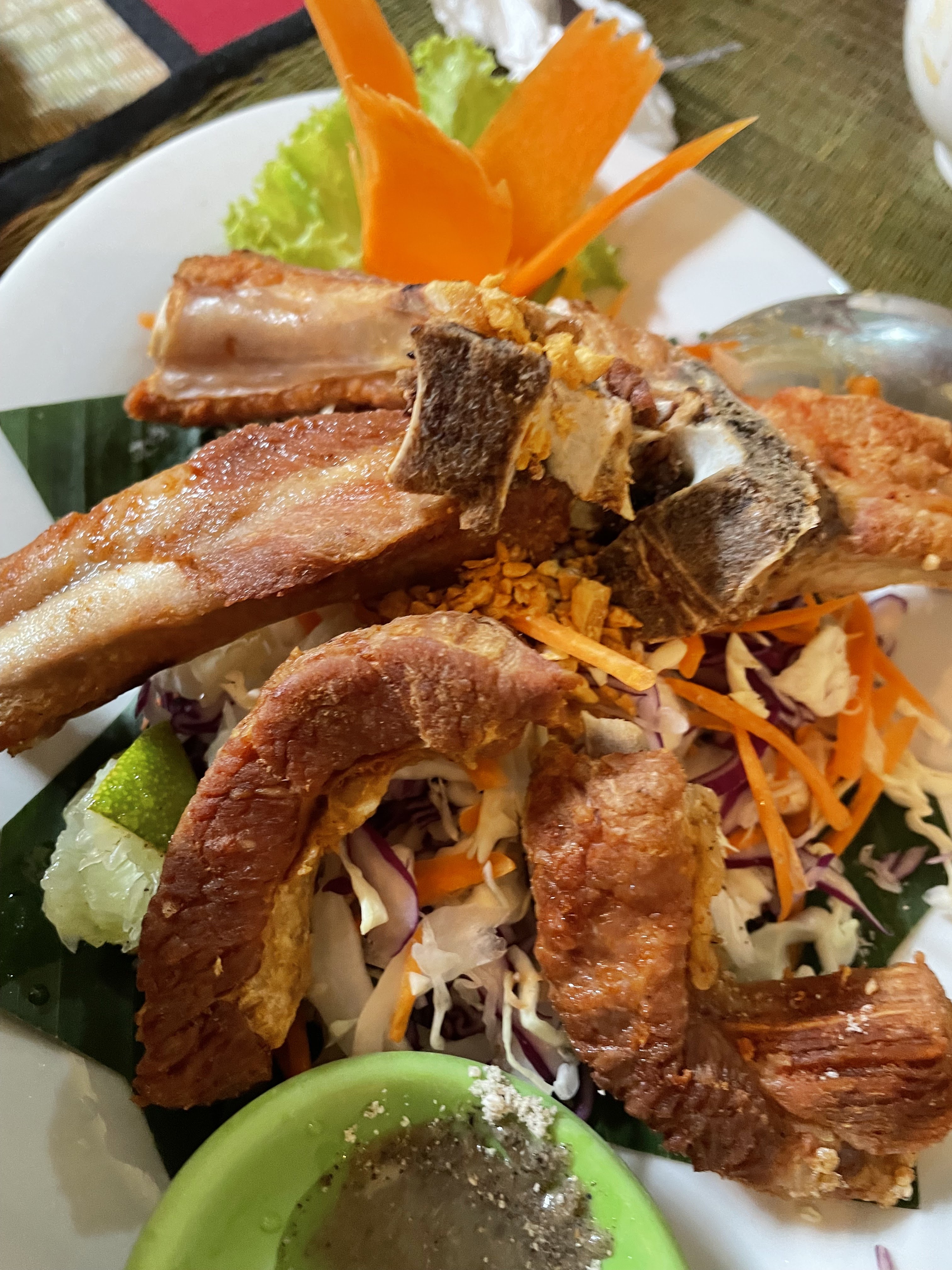 |
| Pork ribs |
The Pork ribs was very dry and tough, tasted like pork jerky.
 |
| Amok |
Angkor - The driver brought us to Khmer restaurant which is on the way to Ta Phrom temple.
|
| Stir-fried vegetables with cashew nuts |
|
| Phad Thai seafood |
|
| Pork ribs |
|
| Amok |
Angkor - A short drive from Angkor wat, we reached Bayon Temple - this unique temple is the last to be built in the Khmer Empire. Bayon is in the heart of the ancient city of Angkor Thom, which was the symbolic center of the Khmer empire.
Bayon is located in the exact center of the Angkor Thom complex, precisely 1.5km from both the North and South gates, and can be entered from any point. Unlike many of the other Angkor temples, Bayon has no moats or surrounding walls. It is protected on all sides by the city of Angkor Thom itself.
 |
| Stone face of Bayon |

 |
| Carvings on the outer wall |
The famous carvings on the outer wall of the first level depict vivid scenes of everyday life in 12th-century Cambodia. These carving depict Khmer soldiers march off to battle with elephants and the ox-carts.
Angkor - Tonle Om Gate also called 'the south gate of Angkor Thom' is a very famous spot within Angkor Archeological Park.
 |
| Naga Balustrade |
 |
| Multi-headed Giant |
 |
| Tonle Om Gate |
The Southern Gate of Angkor Thom, or Tonle Om Gate, is one of the five ancient gates dated to the 12th century providing access through the 8m high laterite walls of Angkor Thom. The South Gate features the best restored causeway, recreating the awe-inspiring effect that surely must have been one of the original intentions of its ancient master architects.
 |
| cars driving through narrow gate |
Angkor - Woke up early at 3.45am to catch the 4.30am sunrise tour of Angkor wat. This massive temple complex in Cambodia and is the largest religious monument in the world, on a site measuring 162.6 hectares (1,626,000 m2; 402 acres). Originally constructed as a Hindu temple dedicated to the god Vishnu for the Khmer Empire by King Suryavarman II, it was gradually transformed into a Buddhist temple towards the end of the 12th century; as such, it is also described as a "Hindu-Buddhist" temple.
The early civilisation of the Khmer kingdom following the belief of their King were Hindus but gradually move to the religion of Buddhism. I watched and read about the wonders of Angkor wat but nothing can replaced actually seeing it in front of me.
The city of Angkor is spread out over an area of about 40 x 40 miles and was the capital of the Khmer empire from AD 800 to 1200 and was abandoned in 1431.
Unlike most Angkorian temples, Angkor Wat is oriented to the west.
It was a short 7km drive to Angkor wat and had to stop at a ticket station to pay the US$ 37 for entrance fee, Cambodia accepts US$ as their transactional currency and will return the loose change of US$ or US$5 in their Cambodian rial at an exchange rate of US$1 to 4,000 Riel. Cambodia has de-dollarization the small US notes of $1, $2 and $5 out of circulation.
The Angkor entrance fee counter staff will reject US$ if they are ripped, torn, or slight stain; although you can expect to see filthy riel in circulation. Old-style US bills are also not welcome, so make sure that the cash you bring is fairly new.
 |
| A group pic taken at 6.40am in the morning |
 |
| Perfect pic at the Angkor Library |
 |
| Cool pic of the 4 of us |
 |
| Balustrade ruin of Naga |
Naga is an mythical figure in Cambodia which takes the form of a seven-headed snake, often carved as a balustrade and found on causeways leading to temples or palace buildings.
 |
| Restoration work on the balustrade |
There are many restoration work being done at Angkor wat as it is a huge temple complex, mostly restored by France and Germany. The restoration of cement quite evident in the difference in colour and texture to the original.
 |
| Right Balustrand |
 |
| Left of the Balustrand |
 |
| The causeway to Angkor wat |
Angkor wat had 12 towers and these 3 is the icon of the Cambodia flag. Currently, only 9 left with 3 towers collapsed in ruins.
 |
| On the wooden steps of Angkor temple |
The restoration includes wooden ramps and steps as the original steps carved from strones lay in ruins and too dangerous to be step on.
 |
| Sunken bathing pool |
The King and priest to cleanse themself before entering the inner Angkor temple.
 |
| One of the tower of Angkor wat |
 |
| In front of the Temple steps |
These steps was constructed for tourist as the original steps were steep and slippery. Today is Buddha's holiday in Cambodia so no tourist allowed to climb the steps to the top of the temple.
 |
| Hindu inspiration on the walls of Angkor Wat |
 |
| Us and our Cambodian tour guide |
 |
| The original causeway across the moat under restoration |
 |
| The floating temporary causeway |
Siem Reap - One of the popular Khmer restaurant in Siem Reap and it was quite full. Mostly foreigners filled this restaurant. The menu has one page of Khmer food and 3 pages of Thai dishes. The owner was friendly and explained that her sister was a chef in Bangkok for many years for the many Thai dishes. Sambo is the name of her father.
Location: Wat Damnak, Krong Siem Reap, Cambodia
 |
| Lesley, me, Donny & Edward |
 |
| Fresh spring roll |
 |
| Sir Fried Ginger |
This dish tasted different as instead of using ginger, the Chef used blue ginger - it did not blend well.
 |
| Amok |
 |
| Khmer Red curry |
 |
| Fried Khmer fish |
 |
| Hot holy basil |
 |
| Stir fried morning glory with garlic |
Siem Reap - Going to Siem Reap with my good friends, flying SQ there. It was a full flight and the plame arrived on time.
 |
| My SQ flight to Siem Reap |
Lunch was at Khmer Kitchen restaurant, quite a popular Khmer lunch location.
Location: Street 2 Thnou the corner of street 9, Old market Siem reap, 17255, Cambodia
 |
| Khmer Kitchen restaurant |
 |
| Edward, Donny, Lesley and I |
 |
| Fresh spring roll |
This Khmer fresh spring roll tasted good and the difference with Vietnamese fresh spring roll is the use of bean sprouts.
 |
| Amok with chicken |
Amok is a famous Cambodian dish has a rich taste of coconut, amok paste (amok is made with a fine, flaky white fish), long beans, onion, and noni leaf. In the Cambodian culture the noni tree has many uses. You can use it as a traditional medicine, food or juice, also you can also use it as a cosmetic. The Noni tree fruit has green colour when it still young, then becomes yellow and at the end white when it is ripe. When the fruit ripen it has a strong unpleasant smell.
 |
| Pineapple with beef |
The pineapple was sweet and it blended well with the beef as a dish but the beef was tough and not well seasoned.
 |
| Lok Lak with pork |
Lok Lak is usually served with sliced beef but we ordered pork instead, marinated and then sautéed in a wok before being served on a bed of green salad with slices of tomatoes and cucumber that bring freshness to the dish.
Lok lak is a very popular dish in Cambodia but it originated from Vietnam, where it is called bò lúc lắc. Bò means “beef” and lúc lắc means “stir” or “shake”. This term evokes the movement of the diced meat in the wok.
 |
| Omelette and Broma fish |
This dish is a pan fried fermented broma fish with egg. For centuries, prahok (fermented fish paste) has sat at the heart of local cuisine, entrenched deeply in Cambodian culture. Today, the condiment whose pungent smell, continues to be the star ingredient in an array of vegetable, meat and rice dishes, as well as soups.

 |
| California sushi roll |
 |
| Fried rice |
 |
| Deep fried chicken |
 |
| Prawn soup served in a tea pot |
 |
| Grilled salmon with Teriyaki sauce |
 |
| Sashimi |
Singapore - Located in the heart of Chinatown, People’s Park Food Centre is one of Singapore’s long-established hawker centres, offering a...


